

Bifacial solar panels with HJT technology are now gaining popularity due to their quicker payback compared to traditional crystalline silicon panels nearing their efficiency limit.
What are bifacial solar panels used for?
Bifacial panels can capture light on both sides, unlike traditional solar panels that capture light only on one side, enabling them to absorb both direct sunlight and reflected light from nearby surfaces.
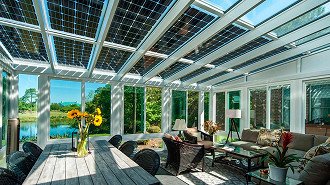
Three categories are identified based on the material of the second surface: glass/glass, glass/clear sheet, and opaque glass/sheet. The initial option is considered the most effective and durable, although it is also the priciest and heaviest, resulting in reduced popularity.
The newest advancement in bifacial technology
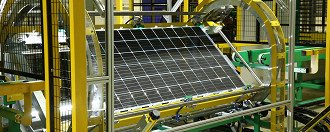
The most recent bifacial modules incorporate heterojunction technology (HJT), combining two distinct semiconductor materials, crystalline silicon and amorphous silicon. This advanced type of photovoltaic cell involves applying an amorphous silicon layer on both sides of a crystalline silicon cell to form a heterojunction.
Amorphous silicon has a broader band gap compared to crystalline silicon, enabling it to capture high-energy photons effectively. When combined in a heterojunction, the two types of silicon can achieve better light absorption and minimize efficiency losses caused by electronic recombination.
The HJT panels were first created by the Japanese company Sanyo in the 1980s. Other manufacturers have since enhanced and implemented this technology for commercial production, reducing the reliance on materials like silver in the photovoltaic industry.
chsyys/iStock
Modules that are longer-lasting
The HJT cell in modern modules features a balanced front and rear design, boosting the rear’s energy output by 30%. This results in quicker cost recovery for the typically high installation expenses of bifacial panels.
The new Two-sided HJT modules experience reduced deterioration and are more tolerant to high temperatures compared to conventional solar panels, enabling manufacturers to provide warranties lasting for many years.
When are they beneficial?
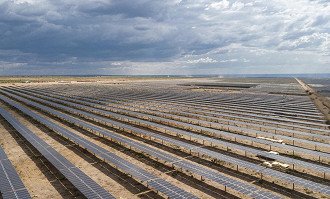
Bifacial solar panels of the latest generation can be beneficial in high-latitude regions with low sunlight angles, as they can harness reflected light from snow and other surfaces. They are also advantageous in locations with high soil reflectivity, like desert sand or white roofs of large industrial or commercial buildings.
Bifacial panels can be utilized in agriculture on crops that can benefit from sunlight passing through the glass. They can also be placed on large bodies of water to make use of reflected light and aid in protecting them from increasing temperatures.

Bifacial panels are promoted as a shade-providing alternative to awnings and pergolas. However, they are better suited for public applications in vertical setups like marquees, bridges, facades, and dual-sided road acoustic barriers in their more effective forms.

