

Apple’s anticipated Vision Pro is now officially accessible to customers in the United States starting from Friday (2), following a pre-sale period that commenced on January 19. Apple has begun shipping the devices to customers who made advance purchases.
The virtual and augmented reality glasses, priced at $3,499 initially, equivalent to around R$17,000 in direct conversion, aim to transform how users engage with technology.
The company highlights the innovative user interface, enabling natural gestures like interacting with apps by gazing at them, tapping fingers to choose, shaking the device to scroll, or utilizing a virtual keyboard and voice commands for typing.

Vision Pro is compatible with 4K resolution videos, features 6 microphones, 12 cameras, and weighs around 600 grams. It runs on the visionOS platform and is equipped with two main chips – the M2 for system operation and the R1 for image processing.
Apple provides storage options of 256 GB, 512 GB, and 1 TB, and emphasizes its collaboration with Zeiss, which enables users to attach magnetic lenses for an extra fee of up to US$ 149 (approximately R$ 750) for those requiring prescription glasses.
View the video showcasing the product presentation.
Apple Vision Pro’s main characteristics
- Price: US$ 3,499 is equivalent to approximately R$ 17,000.
- Weight: 600 grams
- Video Quality: 4K
- Microphones: six
- Cameras: Twelve
- Storage options include 256 GB, 512 GB, and 1 TB.
- Operating System: views
- Primary Chips: M2 (system), R1 (image processing)
- Magnetic Lenses (if desired): costing up to $149
- Intuitive gestures and voice recognition make the interface user-friendly.
- Approximately 2 hours of battery life.
- Zeiss collaborates for magnetic eyewear.
Are you planning to visit Brazil?
Apple has not yet announced a specific release date for the product in Brazil. They are marketing Vision Pro as a groundbreaking spatial computer that will change how people work, interact, and enjoy entertainment, without using the term “metaverse” coined by Mark Zuckerberg.
Challenges and anticipated outcomes.
The virtual reality sector has experienced fluctuations, with various technologies such as Google Glass and standalone headsets. Apple, typically entering markets later, focuses on high quality to attract consumers with its Vision Pro product. However, the success of Vision Pro remains uncertain due to competition and concerns about fatigue from using facial devices.
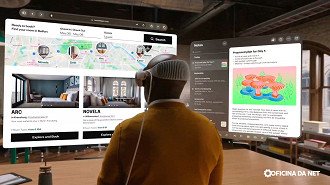
Apple aims to promote Vision Pro as a productivity tool that can replace laptops by offering a virtual screen, digital keyboard, and gaming capabilities. Overcoming historical hesitations due to discomfort and limited engaging applications is a key challenge.
Vision Pro marks a major advancement for Apple in its progress towards “space computing”, with its success hinging on the company’s capability to tackle the challenges that have traditionally impeded virtual reality devices.
Feedback

chsyys/UnPlash
Marques Brownlee conducted a thorough evaluation of the Apple Vision Pro after using it for a week. He emphasized its impressive features like immersion, eye tracking, and manual control, while also noting difficulties such as weight, comfort, battery life, and high cost. A comprehensive review is expected soon.

